
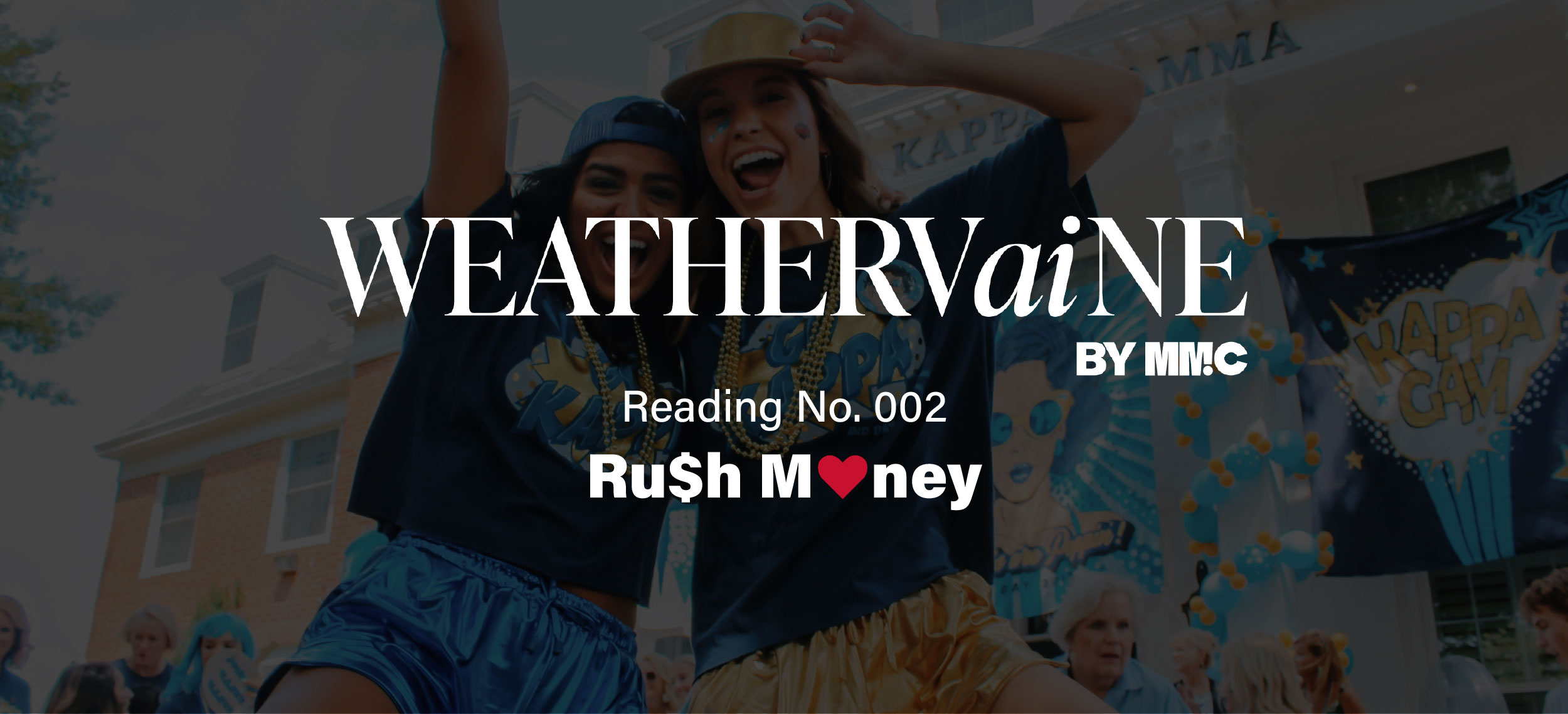

The University of Alabama planted the seeds of #RushTok back in 2021, a phenomenon that went viral in 2022–2023 as other campuses caught on as college life recovered from the pandemic. In recent years, incoming freshmen have had a front-row seat to the full cultural machine that is sorority rush.
Now, data from our WEATHERVaiNE cultural insights platform shows that the 2026 rush class was all business. This cohort has fully transformed rush from a social experience into a commercial one, revealing significant shifts in the values and value expression of Gen Z women.
Money Became the Throughline
Rush has always involved status, spending, and social stakes. But in 2026, money became a defining feature of the conversation. Across our directional analysis of 1,451 LLM-generated responses about sorority rush, financial considerations appeared in 63% of responses, making it the second-most prominent theme behind basic recruitment mechanics.
That financial signal showed up in three distinct ways.
Three cultural shifts emerged from this signal, each pointing to a broader change in how young women are relating to community, status, and their own futures:
Rush unfolded as a rolling content environment, with brands and creators embedding themselves across a full sequence of moments, from GRWMs to bid-day reveals. The most visible brand activity was a story told episode by episode.
Overt luxury is losing ground to a more calculated kind of polish. Rush conversations increasingly weigh whether a look or an outfit choice feels genuine and financially savvy rather than simply expensive. But there is a tension here: Fifty-four percent of rush responses considered whether content felt authentic or staged. Meanwhile, mainstream and
accessible-premium brands carried the appearance conversation far more than luxury labels.
Sisterhood is increasingly framed as an investment. Rush conversations point to a mix of:
Preparation now often begins months in advance, with services and coaching signaling a professionalized approach to what used to be a purely social process.
Why Now? A Convergence of Pressures
These shifts reflect a convergence of forces shaping how Gen Z women are approaching one of college life's most visible rituals.
Gen Z women are navigating a moment where acceptance and security feel precarious. Having watched rush become a public spectacle in the years before they went through it themselves, this year's class entered recruitment already asking a sharper question: what is the cost of belonging, and what is tangibly gained from it? These questions turned a social ritual into an investment decision with returns to weigh.
This is a generation raised alongside the creator economy, watching personal brand, content, and monetization become viable paths to opportunity. It's no surprise that rush conversations increasingly treat sisterhood as a network, a platform, and in some cases a launchpad. When your peers can turn a rush TikTok into a brand deal, the social currency of community starts becoming a form of capital as well.
Gen Z women are managing real pressure: affordability concerns, worries about the future job market, and the added complexity of an AI-shaped economy that makes traditional career paths feel less certain. In that environment, relationships, human skills, and personal brand become more valuable. The rush data suggests those very things are increasingly what young women are investing in when they choose a chapter, hire a coach, or curate their presentation.
Put together, these pressures explain why a ritual built on friendship and tradition has taken on the language and behavior of a strategic investment. The act of “belonging” is expected to deliver more
than friendship.
What This Means Beyond Rush
While this report is grounded in sorority recruitment, the shifts it surfaces extend well beyond Greek life. Any brand trying to reach Gen Z women around a high-stakes cultural moment, whether that's a big life transition, a major purchase decision, or a competitive social ritual, should be paying attention to how status, affordability, and future value are being renegotiated in real time.
The full report, Rush Money: What Sorority Recruitment Reveals About the New Economics of Belonging, goes deeper into each of these three shifts, including what they mean for brand communicators and where the opportunities are to show up authentically in these moments.
Methodology
This report is powered by WEATHERVaiNE, our proprietary AI-enabled cultural intelligence insights engine, built in partnership with Bluefish AI. WEATHERVaiNE applies AI as a research methodology, analyzing how large language models interpret conversations unfolding across news, social media, forums, and other shared digital spaces. By comparing those interpretations over time, WEATHERVaiNE identifies
shifts in visibility, sentiment, association, and narrative momentum.
Our cultural strategists and communications experts then translate those signals into practical implications: what's changing, why it matters, and how brands should respond.
For this report, we analyzed 1,451 LLM-generated responses about sorority rush between August 7 and August 21, 2026, layered with proprietary audience data on Gen Z women from Omnicom’s OMNI platform.
Findings are directional and reflect patterns across models, phrasings, and time, not a representative survey of all sorority members, chapters, or campuses.
About WEATHERVaiNE by MMC
WEATHERVaiNE is MMC’s proprietary cultural insights engine, powered by Bluefish AI. Built to bring MMC’s new methodology for understanding culture to life, WEATHERVaiNE uses AI interpretation to identify emerging narratives, behaviors and community dynamics before they become conventional wisdom. MMC applies its communications expertise to translate those patterns into actionable intelligence that can inform communications, marketing, media, partnerships and business strategy. The first reading of WEATHERVaiNE, The Fan-ready Blueprint, explores the forces shaping relevance, participation and connection following the 2026 FIFA World Cup.
Brands can engage MMC for custom WEATHERVaiNE work built around their specific business, marketing, and communications objectives.
To learn more, contact Rachel Heringer, Group SVP, Marketing, MMC: Rachel.heringer@omc.com
About Bluefish
Bluefish is the Agentic Marketing Platform (AMP) for the Fortune 500. The platform helps the world's largest brands track, optimize and measure their performance across major AI platforms like ChatGPT and Google Gemini. Brands including Adidas, Hearst, Tishman Speyer and others use Bluefish to ensure their products and services are accurately portrayed in AI-generated responses consumers see every day. Since launching in 2024, Bluefish has scaled to more than 10% of the Fortune 500, with hundreds of enterprise accounts spanning 15 verticals including travel, financial services, CPG, luxury and beauty. To learn more, please visit www.bluefishai.com.
Exclusive report
Download the Rush Money Report
Complete the form to receive Rush Money: What Sorority Recruitment Reveals About the New Economics of Belonging.

.jpg)


.jpg)
